

Key takeaways
- Find the best telescopes for beginners and families, from compact refractors to a classic Dobsonian, with clear guidance on aperture, mounts, and setup.
A first telescope should make the night sky feel closer, not more confusing. The best telescopes for beginners share a few plain qualities: steady optics, a mount that moves smoothly, eyepieces for low and high views, and a setup a family can finish in one evening. Aperture matters, because a wider opening gathers more light and shows fainter objects, yet a huge tube that stays in a closet helps nobody. Portability and storage space matter just as much as raw size.
As an Amazon Associate, we earn from qualifying purchases.
Quick Answer
For most beginners, the Celestron PowerSeeker 127EQ is the strongest all round pick, with a large aperture and an equatorial mount for longer sessions. The AstroMaster 70AZ is the simplest refractor, the Gskyer AZ70400 is the most portable travel option, the Orion StarBlast II 4.5 suits families wanting a sturdy reflector, and the Orion SkyQuest XT6 is best for viewers ready for a larger Dobsonian.
How to Choose
Start with aperture, the diameter of the main lens or mirror. A 70mm refractor gathers enough light for the Moon and bright planets, while a 114mm or 127mm reflector reaches fainter star clusters and nebulae. A 150mm Dobsonian gathers still more light under a dark sky, but it brings a larger tube and a heavier base. Choose the largest aperture you will actually carry outside often, rather than the largest you can imagine owning.
Focal length shapes the view. A longer focal length gives higher magnification and suits lunar and planetary detail. A shorter focal length gives a wider field, which makes it easier to find star clusters. The mount matters too: an altazimuth mount moves up and down and side to side and feels natural, an equatorial mount follows an object with one slow motion control once aligned, and a Dobsonian rocker box is stable, simple, and low to the ground.
Think about where you will observe. A backyard still suits the Moon, planets, and bright clusters, while a dark site away from town opens up fainter nebulae and galaxies. Check the weight, the tube length, and whether the tripod folds small enough for a car boot or a cupboard. Never look at the Sun through a telescope or finder without a proper solar filter made for that telescope and fitted securely over the front of the optics. A filter that threads into the eyepiece end is not safe, because concentrated sunlight can crack it, so discard one if it arrives with a kit.
Celestron PowerSeeker 127EQ Telescope
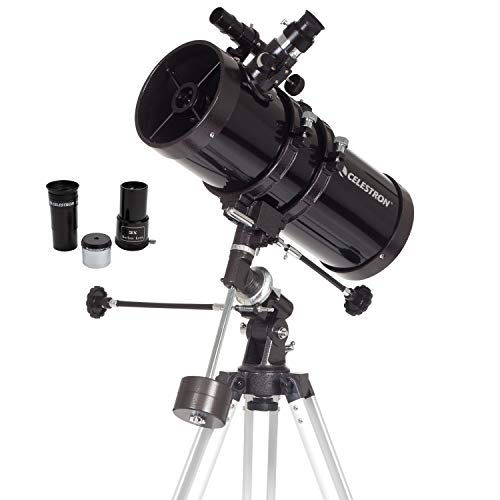
The Celestron PowerSeeker 127EQ is a reflector for beginners who want a clear step up from a small starter scope. Its 127mm aperture gathers a generous amount of light, so lunar craters show crisp detail, Jupiter and its moons are easy to find, and Saturn reveals its rings on a steady night. Bright star clusters and nebulae also come into view when the sky is dark.
The German equatorial mount sets this model apart. Once aligned, it lets you follow an object with a slow motion control instead of chasing it in two directions. That takes a little practice on the first night, yet the reward is a steadier view during longer looks at a planet or the Moon. Two eyepieces and a Barlow lens give a useful range: start with the lower magnification eyepiece to find an object, then switch to a higher one for detail. The Barlow lens triples the magnification of each eyepiece.
Specs
| Feature | Detail |
|---|---|
| Type | Newtonian reflector |
| Aperture | 127mm |
| Focal length | 1000mm |
| Focal ratio | f/7.87 |
| Mount | German equatorial |
| Eyepieces | 20mm and 4mm |
| Barlow lens | 3x |
| Model | 21049 |
Celestron AstroMaster 70AZ Telescope

The Celestron AstroMaster 70AZ is a refractor that keeps first time stargazing simple. Its 70mm lens is fully coated, and the long focal length suits lunar and planetary viewing, where a steady, narrow view helps you pick out craters, cloud bands, and rings. The tube is sealed and needs little care beyond keeping the lens cap on when it is not in use.
The altazimuth mount moves up and down and side to side, so pointing the telescope feels natural from the first minute. The tripod adjusts in height, which helps when adults and children take turns at the eyepiece. Two eyepieces cover low and high views, the erect image diagonal gives a correctly oriented image for daytime land viewing, and a red dot finder helps you aim at the Moon or a bright planet. The kit is light enough to carry into the garden and set up quickly.
Specs
| Feature | Detail |
|---|---|
| Type | Refractor |
| Aperture | 70mm |
| Focal length | 900mm |
| Focal ratio | f/13 |
| Mount | Altazimuth |
| Eyepieces | 20mm and 10mm |
| Finder | StarPointer red dot finder |
| Model | 21061 |
Gskyer AZ70400 Telescope

The Gskyer AZ70400 is a travel friendly refractor for beginners who want a telescope that packs away small and sets up fast. Its 70mm aperture and short 400mm focal length give a wide field of view, which makes it easier to locate the Moon, bright star clusters, and large constellations. A wide view is forgiving when you are still learning to aim.
The altazimuth mount is simple to use, and the whole kit folds down for transport. A carry bag keeps the tube, tripod, and accessories together for camping trips or visits to a dark sky site. A phone adapter holds a phone at the eyepiece to capture a simple image of the Moon, and a wireless remote helps you take that image without shaking the telescope. This suits a family with younger children, a traveller with limited storage, or anyone who wants a low commitment first scope. Setup takes minutes, bright planets still show detail, and the Moon fills the view with craters and shadows.
Specs
| Feature | Detail |
|---|---|
| Type | Refractor |
| Aperture | 70mm |
| Focal length | 400mm |
| Focal ratio | f/5.7 |
| Mount | Altazimuth |
| Included | Carry bag, phone adapter, wireless remote |
| Model | AZ70400 |
Orion StarBlast II 4.5 Equatorial Reflector Telescope
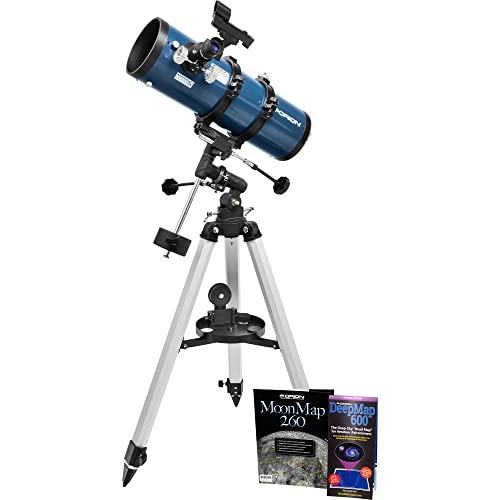
The Orion StarBlast II 4.5 is a reflector that gives a family a serious step into deep sky viewing without a large tube. Its 114mm mirror gathers noticeably more light than a 70mm refractor, so star clusters resolve into individual points, bright nebulae show shape and texture, and the planets gain detail. The short focal length keeps the field wide, which helps when scanning for a cluster.
An equatorial mount lets you track an object with a slow motion control once aligned, which is useful for a longer look at Jupiter or a nebula. Two Sirius Plossl eyepieces give low and high views, the EZ Finder II reflex sight helps you point the tube, and a Moon map helps you name the craters and seas you see. The assembled telescope is heavier than a small travel refractor, so plan a fixed spot in the garden or a short carry to the driveway. Set the tripod on level ground, balance the tube, and start with the Moon before moving to fainter targets.
Specs
| Feature | Detail |
|---|---|
| Type | Newtonian reflector |
| Aperture | 114mm |
| Focal length | 450mm |
| Focal ratio | f/4 |
| Mount | Equatorial |
| Eyepieces | 25mm and 10mm Sirius Plossl |
| Finder | EZ Finder II reflex sight |
| Included | MoonMap 260 |
Orion SkyQuest XT6 Classic Dobsonian Telescope
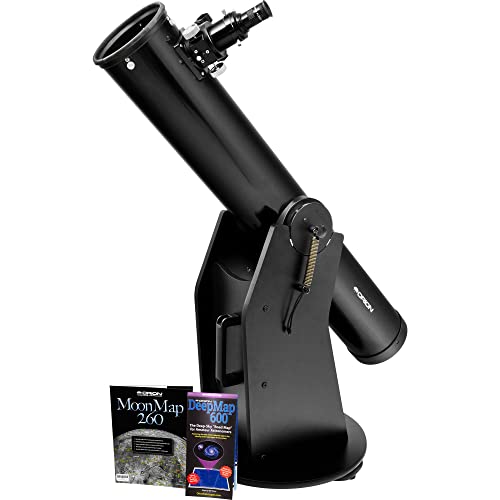
The Orion SkyQuest XT6 Classic is a Dobsonian reflector for viewers ready for a larger aperture and a rock steady mount. Its 150mm mirror gathers a strong amount of light, so globular clusters resolve into a dense ball of points, bright galaxies show a soft glow with a brighter core, and the planets hold detail at higher magnification. Under a dark sky, this reaches the faintest objects in this guide.
A Dobsonian mount is a simple wooden rocker box that sits on the ground. You push the tube gently to aim it, and the base stays stable while you observe. There is no tripod to wobble in a breeze, and the low centre of gravity makes the assembly feel secure. Setup means placing the base on flat ground, lifting the tube into the cradle, and inserting an eyepiece.
This telescope needs space. The base is broad, the tube is long, and the assembled instrument is best kept in a garage, shed, or large cupboard near the door. Choose the SkyQuest XT6 if you already know you enjoy stargazing and want a telescope that will keep pace with your interest for years.
Specs
| Feature | Detail |
|---|---|
| Type | Newtonian reflector, Dobsonian |
| Aperture | 150mm |
| Focal length | 1200mm |
| Focal ratio | f/8 |
| Mount | Dobsonian rocker box |
| Model | 8944 |
Who Should Skip It
A beginner telescope is not the right buy for every household. Skip a full size telescope if you have no dark outdoor space, no safe storage near a door, and no time to set it up after dark, because a telescope that never leaves a cupboard teaches nobody anything.
Skip an equatorial mount if aligning a mount fills you with dread and you only want ten minutes of Moon viewing now and then. An altazimuth refractor or a Dobsonian will feel easier, and an easy telescope gets used more often. Skip a large Dobsonian if you live in a flat with stairs and no lift, or if you must carry it far across uneven ground. Skip a tiny aperture scope with a shaky tripod if your main goal is faint galaxies, and save for a larger reflector instead.
FAQ
What aperture is best for a first telescope?
A 70mm refractor is a fine start for the Moon and planets, while a 114mm or 127mm reflector reaches fainter clusters and nebulae. A 150mm Dobsonian gathers still more light under a dark sky. Choose the largest aperture you will carry outside often.
Is a refractor or a reflector better for beginners?
A refractor is simpler to care for, needs little adjustment, and gives a clean view of the Moon and planets. A reflector gives more aperture for a similar tube length and shows fainter deep sky objects, although mirrors need occasional alignment.
How do I find objects with a beginner telescope?
Start with the Moon, because it is bright, easy to find, and full of detail at low magnification. Use the finder to centre a bright planet or star, then switch to a higher magnification eyepiece.
Can children use these telescopes?
Children can enjoy every telescope in this guide with adult supervision, and a simple altazimuth refractor is the easiest for a young observer to aim. Set the tripod low, let the child look through the low magnification eyepiece first, and keep sessions short and focused on the Moon or a bright planet.
Final Verdict
The best telescopes for beginners balance aperture, mount, portability, and ease of use. The Celestron PowerSeeker 127EQ leads for most buyers, with a large aperture and an equatorial mount for longer sessions. The AstroMaster 70AZ is the simplest first refractor, the Gskyer AZ70400 is the easiest to travel with, the Orion StarBlast II 4.5 brings a brighter reflector view to families, and the Orion SkyQuest XT6 rewards a committed observer with the deepest views. Start with the Moon, learn a few constellations, and give yourself several evenings to learn the mount. Pick the telescope that fits your home, storage, and observing habits, and the night sky will repay that choice many times over.
Product and ASIN Reference
| Product | ASIN |
|---|---|
| Celestron PowerSeeker 127EQ Telescope | B0007UQNKY |
| Celestron AstroMaster 70AZ Telescope | B000MLHMAS |
| Gskyer AZ70400 Telescope | B081RJ8DW1 |
| Orion StarBlast II 4.5 Equatorial Reflector Telescope | B06XSM4R74 |
| Orion SkyQuest XT6 Classic Dobsonian Telescope | B001DDW9UW |
More from Amazon
Programs that pair well with the guide above. Offers and eligibility are set by Amazon and may change.
Free shipping on eligible items, Prime Video and more. Eligible new members can start with a free trial.
Start a Prime free trialAudiobooks and podcasts to listen to on the go. Eligible new members can start with a free trial.
Try Audible freeAd-free music streaming. Eligible new subscribers can start with a free trial.
Try Music Unlimited freeA free business account with business pricing and bulk-buying tools for work, shop or home office.
Create a business accountAs an Amazon Associate we earn from qualifying purchases.






Write Your Review
No reviews yet. Be the first to share your experience!