

Key takeaways
- Poach eggs neatly every time with the best egg poachers, from stainless stovetop pans for brunch crowds to microwave cups for one or two eggs in minutes.
- Top Pick: Cuisinart Egg Central Egg Cooker
- Runner-up: ExcelSteel 6 Cup Egg Poacher
- Also consider: ExcelSteel 4 Cup Egg Poacher
Poaching eggs freehand in swirling water is a skill that produces a lot of wispy failures before it produces breakfast. An egg poacher removes the guesswork by holding each egg in its own cup over or in simmering water, so the white sets around the yolk in a tidy, compact shape every time. The category covers three formats: electric cookers that poach as part of a larger egg-cooking system, stovetop pans with nonstick cups set into a covered skillet, and small microwave poachers that handle one or two eggs with almost no cleanup. Which format suits you depends on how many eggs you poach at once and how often eggs Benedict actually happens in your kitchen. The five picks below span all three formats, from a six-cup brunch pan to a two-cavity microwave cup.
As an Amazon Associate, we earn from qualifying purchases.
Quick Answer
For brunch crowds, the ExcelSteel 6 Cup Egg Poacher is the pick: a stainless pan with six nonstick cups that works on induction. The Cuisinart Egg Central is the best electric option and poaches four eggs while also boiling ten. For one or two eggs with minimal fuss, choose the Nordic Ware microwave poacher; the four-cup ExcelSteel and the Bakerpan silicone cups fill the middle ground.
How to Choose
Capacity comes first. A six-cup pan poaches for a table of eggs Benedict at once, while a two-cup microwave poacher matches a single breakfast. Buying far beyond your real headcount just adds storage bulk, since poacher pans are wide and awkward in a cabinet.
Format is the second decision. Stovetop pans give the most traditional result and the largest batches, and stainless models work on any burner including induction. Electric cookers automate the water and timing, which helps distracted cooks, but poaching is usually a side function of a machine bought mainly for boiled eggs. Microwave poachers are the fastest and smallest option, though they reward a little practice: times vary by microwave, and the yolk should be pierced before cooking as the instructions direct.
Look at the cups themselves next. Nonstick coatings release eggs cleanly and are standard on stovetop pans; a light greasing still helps. Cups that lift out individually make serving easier, and a glass lid lets you watch the whites set without lifting the cover and losing steam. Finally, consider the pan’s second life: several stovetop models work as a regular skillet once the insert comes out, which earns back their storage space.
Cuisinart Egg Central Egg Cooker

The Cuisinart Egg Central, model CEC-10, is an electric cooker that treats poaching as a first-class function. Its poaching tray holds four eggs, the largest electric poaching capacity in this roundup, and a separate omelet tray holds three. In its main role the two-tier system cooks up to ten eggs in their shells to hard, medium, or soft, driven by a 600-watt heater with an audible alert and a brushed stainless steel lid.
For a household that boils eggs for the week and poaches on weekends, this single appliance covers both jobs without a pot of water on the stove. The measuring beaker with a piercing pin is included, and the trays lift out for washing. The honest limitation is batch thinking: poaching four eggs is easy, poaching eight means running the tray twice. Buy it if eggs in several forms are a weekly routine and you value set-and-forget timing over stovetop control.
Specs
| Feature | Detail |
|---|---|
| Model | CEC-10 |
| Poaching capacity | 4 eggs in poaching tray |
| Boiling capacity | 10 eggs in shells |
| Extra tray | Omelet tray for 3 eggs |
| Power | 600 watts |
| Best for | Boiling and poaching in one unit |
ExcelSteel 6 Cup Egg Poacher

The ExcelSteel six-cup poacher is the traditional brunch workhorse. The pan is built from 18/10 stainless steel with six nonstick egg cups set into an insert, a glass lid for watching progress, and a base that works on induction cooktops as well as gas and electric burners. Six eggs poach at the same time, which is the difference between serving eggs Benedict to a table together or in shifts.
Stainless construction is the long-term argument here: the pan body will outlast several sets of nonstick cups, and the deep base works as a covered skillet for other cooking once the insert is removed. The cups benefit from a light coating of butter or spray before the eggs go in, and the wide pan needs a burner that matches its diameter for even simmering. For households that poach for four or more people, this is the most capable and durable design in the category.
Specs
| Feature | Detail |
|---|---|
| Capacity | 6 egg cups |
| Material | 18/10 stainless steel |
| Cups | Nonstick, removable insert |
| Cooktops | Induction, gas, and electric |
| Lid | Glass with handle |
| Best for | Brunch for a crowd |
ExcelSteel 4 Cup Egg Poacher
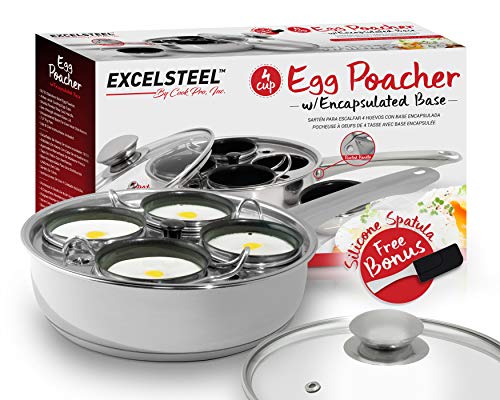
The four-cup ExcelSteel scales the same idea down for smaller households. It uses the same 18/10 stainless steel construction and nonstick cups, in a pan sized for one to four eggs at a time. The listing notes that the base doubles as a 7.5-inch frying pan with the insert removed, which makes it a genuinely dual-purpose piece of cookware rather than a single-task gadget.
In the box are the four poacher cups, the base pan, the insert plate, and the lid. For couples, the four-cup size hits a sweet spot: two eggs each for Benedict, or a single pair without heating a wide pan. It shares the six-cup model’s care routine, including greasing the cups lightly and washing the nonstick surfaces without abrasives. Choose this size if your poaching is frequent but your table is small, and the bonus skillet function helps it earn its cabinet space.
Specs
| Feature | Detail |
|---|---|
| Capacity | 4 egg cups |
| Material | 18/10 stainless steel |
| Second use | Base doubles as a 7.5-inch frying pan |
| Cups | Nonstick on insert plate |
| Includes | Cups, base pan, insert, and lid |
| Best for | Couples and small households |
Nordic Ware Microwave 2 Cavity Egg Poacher

The Nordic Ware 64702 is the smallest and simplest poacher here: a two-cavity plastic tray with a lid that goes straight into the microwave. Each cavity takes a small amount of water and one egg, and Nordic Ware’s own directions have you pierce the yolk before closing the lid. Cooking takes about a minute depending on the microwave, which makes it the fastest route to a single poached egg for a sandwich or a salad.
The material is BPA-free plastic per the maker, the whole thing rinses or goes in the dishwasher, and it stores in a drawer. Results depend on learning your microwave’s timing, since a few seconds either way changes the yolk, and the two-egg ceiling is firm. As an inexpensive, near-zero-effort way to poach an egg or two, though, it has earned its long-running popularity. It is also a sensible first poacher for dorms and offices where a stove is not available.
Specs
| Feature | Detail |
|---|---|
| Model | 64702 |
| Capacity | 2 eggs, one per cavity |
| Material | BPA-free plastic per maker |
| Method | Microwave with water in each cup |
| Cleanup | Rinses clean, dishwasher safe |
| Best for | One or two eggs, no stove needed |
Bakerpan Silicone Microwave Egg Cooker

The Bakerpan set takes the microwave idea and makes it modular. It includes four individual silicone cups, each about 4.75 inches across with its own lid, and each cup is collapsible for flat storage. A cup holds up to one and a half cups by volume, so it handles a large egg with room to spare, and the set lets you cook eggs in parallel or keep spares ready for guests.
Silicone brings two practical advantages: eggs release easily, and the cups flex rather than crack if dropped. Because each cup is separate, you can poach one egg or four without a dedicated appliance, and the cups also work for small steamed portions beyond eggs. The trade-off against the Nordic Ware is handling: individual cups with lids are slightly more fiddly than one hinged tray. For renters and small kitchens that want poaching capacity without a pan or an appliance, this set is the flexible option.
Specs
| Feature | Detail |
|---|---|
| Set size | 4 individual cups with lids |
| Material | Silicone, collapsible |
| Cup size | About 4.75 inches across |
| Capacity | Up to 1.5 cups per cup |
| Method | Microwave, one egg per cup |
| Best for | Flexible small-batch poaching |
Who Should Skip It
Skip a dedicated poacher if you poach eggs only a few times a year; a ramekin in a pot of simmering water handles the occasional eggs Benedict without buying anything. Confident freehand poachers who like a rustic, swirled white will find cup-poached eggs almost too tidy. Anyone cooking for a crowd larger than six should also think twice, since even the biggest pan here works in batches. And if your egg routine is mostly boiled or scrambled, an electric egg cooker without a poaching tray, or a plain saucepan, covers it.
FAQ
Do cup-poached eggs taste different from freehand poached eggs?
The flavor is the same, since the cooking method is still gentle heat and steam around the egg. The difference is shape and texture at the edges: cups produce compact, uniform eggs without wispy strands, which is why they plate neatly on muffins and toast. Some cooks prefer the softer folds of a freehand egg, but for consistency the cup wins.
How do I stop eggs sticking to the poacher cups?
Grease the cups lightly with butter or cooking spray before adding the eggs, even when the cups are nonstick or silicone. Eggs release best while still warm, so lift them out promptly with a spoon or small spatula rather than letting them sit and cool in the cup.
Can I poach eggs in a microwave poacher safely?
Yes, with two precautions from the makers’ instructions: add the small amount of water specified for each cup, and pierce the yolk with a fork or toothpick before cooking so steam does not build up inside it. Cook in short bursts and let the egg stand briefly, since microwave power varies and carryover heat finishes the white.
Which poacher is best for eggs Benedict for six people?
The ExcelSteel six-cup pan, because it poaches all six eggs at once over one burner and the whites finish together, which matters when hollandaise is waiting. The Cuisinart poaches four per batch, so a round of six means a second short cycle.
Final Verdict
Buy by batch size and format. The ExcelSteel six-cup pan is the brunch answer and the four-cup version suits couples, both in durable stainless with a skillet hiding underneath. The Cuisinart Egg Central is the electric pick for households that boil as often as they poach. For a single egg with no stove and no fuss, the Nordic Ware tray or the Bakerpan silicone cups turn a microwave into a poacher for the price of a drawer gadget.
More from Amazon
Programs that pair well with the guide above. Offers and eligibility are set by Amazon and may change.
Free shipping on eligible items, Prime Video and more. Eligible new members can start with a free trial.
Start a Prime free trialAudiobooks and podcasts to listen to on the go. Eligible new members can start with a free trial.
Try Audible freeAd-free music streaming. Eligible new subscribers can start with a free trial.
Try Music Unlimited freeA free business account with business pricing and bulk-buying tools for work, shop or home office.
Create a business accountAs an Amazon Associate we earn from qualifying purchases.




Write Your Review
No reviews yet. Be the first to share your experience!