

Key takeaways
- Compare electric knife sharpeners by angle, stages, and abrasive, from a 15-degree Trizor converter to a budget two-stage sharpener for everyday knives.
- Top Pick: Chef'sChoice 15XV Trizor EdgeSelect
- Runner-up: Chef'sChoice 1520 AngleSelect
- Also consider: Work Sharp Culinary E5
An electric knife sharpener replaces the skill of holding a steady angle on a stone with guided slots and motor-driven abrasives, so a dull chef’s knife can cut cleanly again in a few passes. The machines differ in three ways that matter. The first is angle: many European and American knives leave the factory at 20 degrees per side, many Japanese and newer knives at 15 degrees, and a sharpener must match or deliberately convert that angle. The second is staging, since coarse stages reshape a tired edge while fine stages and stropping discs polish it. The third is abrasives, where diamond wheels cut fast and run cool, sapphirite wheels are the long-standing alternative, and flexible belts mimic how knives are finished at the factory. The five sharpeners below cover the main approaches, from a premium angle converter to a budget two-stage box.
As an Amazon Associate, we earn from qualifying purchases.
Quick Answer
The Chef’sChoice 15XV Trizor is the best overall pick: its three stages convert everyday 20-degree knives to a finer 15-degree edge and polish serrated blades too. Choose the Chef’sChoice 1520 if your drawer mixes 15- and 20-degree knives, the Work Sharp E5 for belt sharpening with timed cycles, and the Presto EverSharp or Narcissus for straightforward, lower-cost sharpening of standard knives.
How to Choose
Angle compatibility decides everything, so check your knives first. A sharpener set for 20 degrees will slowly re-profile a 15-degree Japanese knife whether you want that or not, and a 15-degree machine will take a long time to bite on a thick 20-degree blade. If your collection mixes both, pick a machine with selectable angles. If it is all one style, a dedicated machine is simpler and faster.
Be honest about blade condition. Electric sharpeners excel at reviving dull, undamaged edges and keeping them keen. A blade with deep chips, a bent tip, or a broken point needs a coarse repair stage at best and professional regrinding at worst; no machine here should be expected to rebuild a badly damaged edge, whatever the marketing implies. Serrated knives are another special case: most electrics can only polish serrations in a final stropping stage, not re-cut them.
Then consider the abrasive system. Diamond stages sharpen quickly with light pressure and are the premium standard. Belt systems like the Work Sharp use replaceable belts and a convex edge profile that many cooks like, at the cost of buying belts over time. Finally, look at the extras that affect weekly use: a scissors slot, a dust collection system, and a footprint small enough to live in a drawer rather than on the counter.
Chef’sChoice 15XV Trizor EdgeSelect

The 15XV is the sharpener this category is measured against. It runs three stages of 100 percent diamond abrasives in the first two stages and a flexible stropping disc in the third, and its signature trick is conversion: it takes a conventional 20-degree factory edge and re-profiles it to the maker’s slimmer 15-degree Trizor XV edge, which slices with noticeably less wedging in dense food. Precision angle guides hold the blade at the correct angle through each pass.
Serrated knives are handled in the stropping stage only, which polishes the serrations rather than re-cutting them, and that limitation is worth understanding before you buy. The machine suits straight-edged kitchen knives of both Western and Asian origin, provided you are happy for the Western ones to become 15-degree knives permanently. For a household ready to standardize on the finer edge, it is the most capable sharpener here.
Specs
| Feature | Detail |
|---|---|
| Stages | 3, diamond plus stropping |
| Angle | 15-degree Trizor XV edge |
| Conversion | Re-profiles 20-degree factory edges |
| Serrated | Polished in the final stage |
| Guides | Precision angle guides |
| Best for | Standardizing on 15-degree edges |
Chef’sChoice 1520 AngleSelect

The 1520 AngleSelect answers the mixed-drawer problem directly. It has dedicated sharpening stages for both edge families: one applies and maintains a 15-degree edge for Asian-style knives, the other a 20-degree edge for American and European knives, and a stropping stage with flexible discs finishes either. The listing notes it covers santoku and traditional single-bevel Japanese edges as well as sports and pocket knives, an unusually wide brief.
Diamond abrasives do the cutting in the sharpening stages, and the guides position the blade so the chosen angle is applied consistently. The practical advantage over the 15XV is that nothing gets converted: your German chef’s knife stays a 20-degree knife and your santoku stays at 15. If your household owns both traditions and wants one machine that respects each, this is the sharpener designed for exactly that drawer.
Specs
| Feature | Detail |
|---|---|
| Stages | Sharpening stages plus stropping |
| Angles | Selectable 15 or 20 degrees |
| Abrasives | 100 percent diamond |
| Coverage | Western, Asian, and single-bevel knives |
| Serrated | Finished in the stropping stage |
| Best for | Mixed collections of knives |
Work Sharp Culinary E5
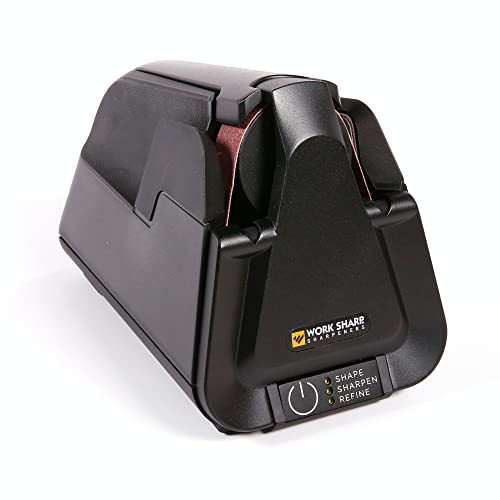
The Work Sharp E5 takes the belt route. Flexible abrasive belts, the same technology used to finish knives at the factory, run through guided slots at a fixed 17-degree angle, and One Touch Programming runs timed cycles so each pass lasts exactly as long as it should. Three settings cover shaping, sharpening, and refining, and a built-in vacuum collects the metal dust that belt sharpening produces, keeping the counter clean.
The package includes a ceramic honing rod with MicroForge technology for maintenance between sharpening sessions. The honest constraints are the fixed angle and the consumables: 17 degrees sits between the two common standards, and owners of strictly 15- or 20-degree knives need the separate upgrade kit with alternate guides, while belts wear and must be replaced. Within those terms, the E5 is the easiest machine here for a nervous beginner, since the timer removes nearly all judgment from the process.
Specs
| Feature | Detail |
|---|---|
| System | Flexible abrasive belts |
| Angle | Fixed 17-degree guides |
| Programs | Timed Shape, Sharpen, and Refine cycles |
| Extras | Built-in vacuum, ceramic honing rod |
| Serrated | Yes, plus scissors per maker |
| Best for | Beginners who want timed guidance |
Presto EverSharp Electric Knife Sharpener
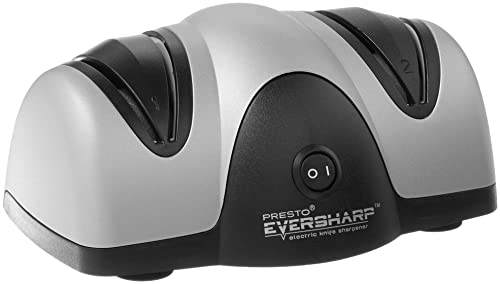
The Presto 08800 EverSharp is the category’s budget veteran, a two-stage machine that has been sharpening kitchen knives for decades. Stage one grinds the edge with Sapphirite wheels and stage two hones it finer, with blade guides that position the knife and a selector that adjusts for blade thickness. There are no angle decisions to make: it is built for the standard edges on ordinary kitchen and sport knives.
The limits are stated plainly by the maker, which is refreshing. The EverSharp sharpens non-serrated blades only, so bread knives and serrated steak knives are excluded, and it is a maintenance and revival tool for dull edges rather than a repair shop for chipped ones. What you get for the modest price is speed and simplicity: draw the blade through each stage a few times and get back to cooking. For a drawer of everyday Western knives, it remains the value benchmark.
Specs
| Feature | Detail |
|---|---|
| Model | 08800 |
| Stages | 2, grind and hone |
| Abrasives | Sapphirite sharpening wheels |
| Blade guide | Adjustable for blade thickness |
| Serrated | Not supported |
| Best for | Budget sharpening of standard knives |
Narcissus Electric Knife Sharpener
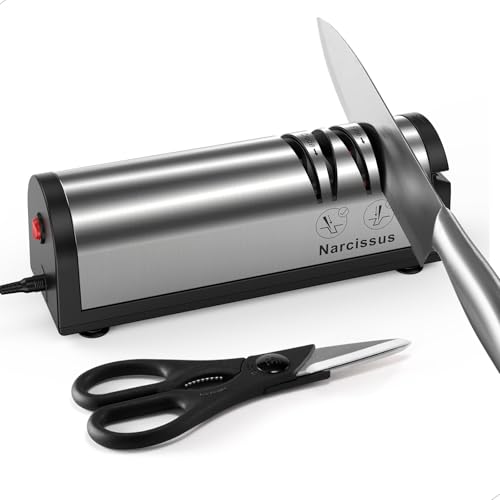
The Narcissus QN-M866 is a compact two-stage sharpener aimed at quick home maintenance. The first stage sharpens coarsely for dull blades and the second polishes the edge finer, and the machine adds two touches the budget field often skips: an open slot on the side for sharpening scissors, and a metal dust collection box that gathers the filings instead of scattering them across the counter.
The stainless steel housing wipes clean and the footprint is small enough for a drawer. Like the Presto, it works within guided angles suited to common stainless kitchen knives, and heavily damaged blades are beyond what its stages are meant to fix; it is a sharpener for edges that have gone dull, not for edges that have been broken. For households that want one inexpensive machine to keep everyday knives and kitchen scissors serviceable, it covers both in a single box.
Specs
| Feature | Detail |
|---|---|
| Model | QN-M866 |
| Stages | 2, sharpen and polish |
| Extra slot | Scissors sharpening on the side |
| Filings | Metal dust collection box |
| Housing | Stainless steel |
| Best for | Everyday knives plus scissors |
Who Should Skip It
Skip an electric sharpener if you own high-end Japanese knives you want kept on stones, since guided electrics remove metal faster and less selectively than careful hand sharpening. Anyone whose knives are chipped, bent, or missing tips should visit a professional sharpener first; these machines maintain edges, they do not rebuild them. Serrated knives mostly cannot be re-cut by any machine here. And if you own two knives you use weekly, a honing rod and an occasional professional sharpening may cost less than a machine.
FAQ
Will an electric sharpener ruin my knives?
Used as directed, no. The real risks are using the wrong angle for the blade, which slowly re-profiles it, and pressing too hard or running a knife through a coarse stage too often, which removes metal faster than needed. Match the machine to your knives’ angles and use the fine stages for routine maintenance.
Can these sharpeners fix a chipped blade?
Only within limits. A coarse or shaping stage can even out very small edge nicks over multiple passes, but deep chips, broken tips, and bent blades need professional grinding. Expecting a home electric sharpener to rebuild a badly damaged edge leads to disappointment and a much thinner knife.
What is the difference between 15-degree and 20-degree edges?
A 15-degree edge is thinner and slices with less resistance, which suits Japanese knives and fine work, but it is more delicate. A 20-degree edge is sturdier and tolerates heavy board work and harder use, which is why most Western knives use it. Neither is better in absolute terms; the sharpener must match the angle your knife was made with, unless you deliberately convert it, as the 15XV does.
Can electric sharpeners handle serrated knives?
Mostly no, with a narrow exception. Serrations cannot be re-cut by guided wheels or belts. Some machines, including both Chef’sChoice models here, can polish serrated edges in a stropping stage, which improves how they cut without changing the teeth. Fully re-sharpening a serrated knife is a specialist job.
Final Verdict
Buy the machine that matches your angles. The Chef’sChoice 15XV is the top pick for cooks happy to move their knives to a 15-degree edge, while the 1520 AngleSelect is the right answer for mixed drawers. The Work Sharp E5 suits beginners who want belts and a timer to make the decisions. On a budget, the Presto EverSharp handles standard knives with no fuss, and the Narcissus adds scissors and dust collection to the same simple formula.
More from Amazon
Programs that pair well with the guide above. Offers and eligibility are set by Amazon and may change.
Free shipping on eligible items, Prime Video and more. Eligible new members can start with a free trial.
Start a Prime free trialAudiobooks and podcasts to listen to on the go. Eligible new members can start with a free trial.
Try Audible freeAd-free music streaming. Eligible new subscribers can start with a free trial.
Try Music Unlimited freeA free business account with business pricing and bulk-buying tools for work, shop or home office.
Create a business accountAs an Amazon Associate we earn from qualifying purchases.



Write Your Review
No reviews yet. Be the first to share your experience!